

Logistics & distribution
Depot-to-depot freight, subcontracted haulage, trailer utilisation and port windows in one place, with proof attached to every leg you invoice.
A container has to clear the Freeport gate by 14:00. At 13:20 nobody in the office can say whether the truck is on the Coast Road or still loading at Ħal Far, so someone starts ringing drivers.
This page is about the middle of the chain — depots, trunking runs, subcontractors and trailers. If your question is "where is my customer's parcel and how do I show them", that is last-mile delivery. If the load is temperature-controlled, see cold chain or refrigerated food delivery.
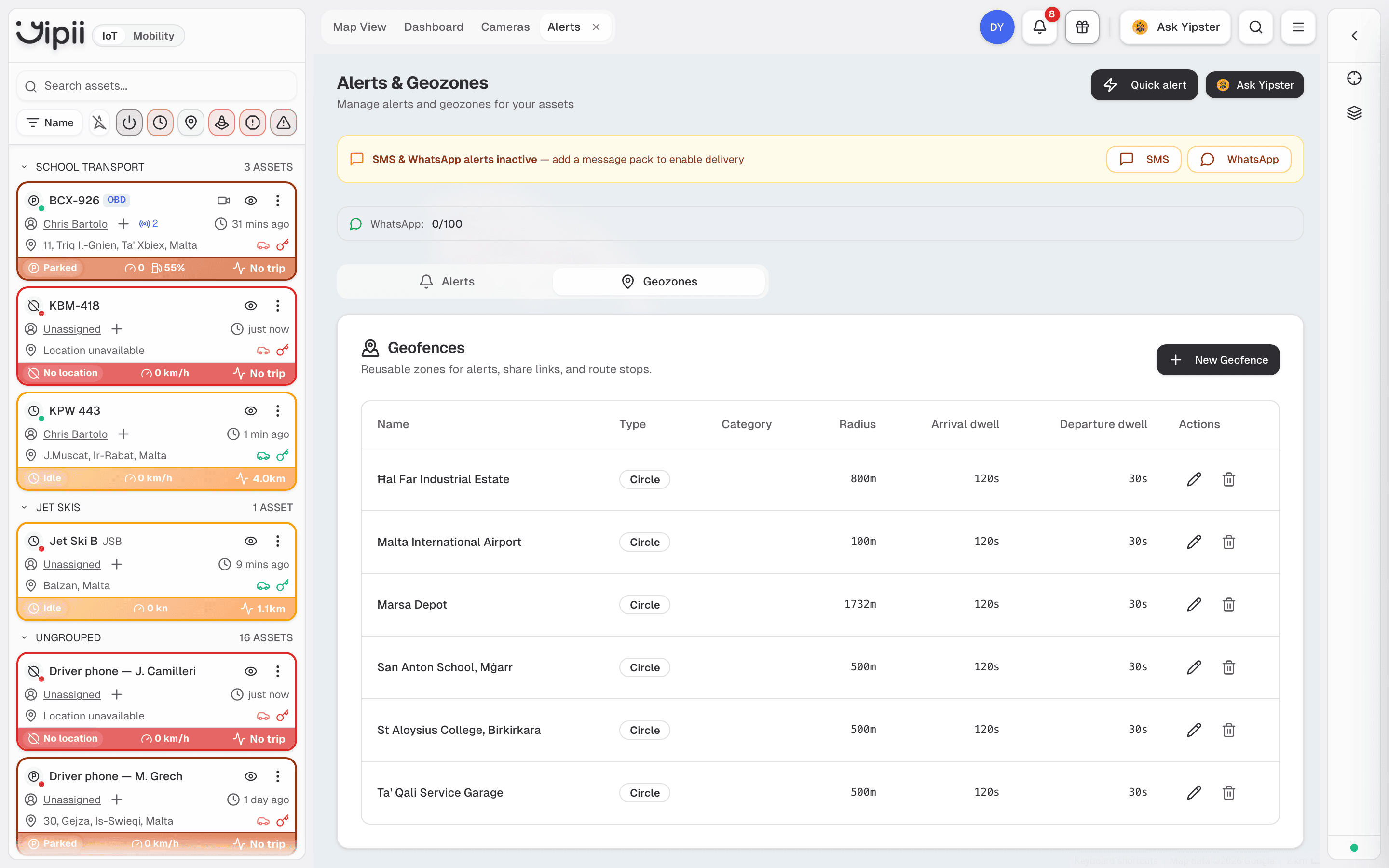
Depots, ports and customer sites drawn once — every arrival, departure and dwell time keys off these.
What goes wrong today
- Missed port and airport windows. A slot missed by 20 minutes becomes a half-day delay and a storage charge, and the first sign of trouble is the phone call after it happened.
- Subcontractors you can't see. Half the fleet on a busy week isn't yours. You're accountable for loads you have no visibility of.
- Trailers nobody can find. Tractors are tracked because they have ignition and power. Trailers, swap bodies and cages get dropped at a yard and become someone's memory problem.
- Demurrage and waiting time you can't evidence. The driver says he waited two hours at the depot. The customer says forty minutes. Nobody has a record.
- Empty running. A truck returns from Gozo empty because dispatch didn't know it was free.
How Yipii handles it
| Problem | What you use | What you get |
|---|---|---|
| Missed slot times | Geofences on ports, depots and airports, with entry/exit alerts | A warning while the run can still be recovered, not a report afterwards |
| Waiting time disputes | Point-visits and stops & idling reports | Timestamped arrival, dwell and departure per site — exportable to PDF or Excel |
| Trailers and unpowered assets | Bluetooth beacons read by the tractor that moved them | A record of which unit carried which trailer, and where it was dropped |
| Subcontractor visibility | Public tracking links issued per load | Your customer sees the load without an account, and without you exposing the fleet |
| Empty running | Live map with the nearest-vehicle lookup | Find the closest free unit to a new job instead of guessing |
| Fuel disappearing | Fuel level tracking with refuel and drain detection | Drops that don't match a refuel get flagged |
| Driver hours and behaviour | Driver scoring and clock-in/out | Speeding and harsh braking by driver, and hours you can put on an invoice |
A day in the life
05:50 — Trunking run leaves Marsa Depot. Exit from the depot geofence starts the clock.
07:10 — The unit enters the Freeport geofence. Dispatch sees arrival without asking.
09:35 — Still inside the geofence. The dwell timer has passed two hours, so the waiting-time report for this customer already has the evidence in it.
11:00 — A same-day job comes in for Mosta. Dispatch uses nearest-vehicle to find the closest free unit rather than sending one out from the depot.
16:40 — Trailer T-14 is dropped at Ħal Far. Its beacon was last read by the tractor that moved it, so the yard sheet is right without anyone writing it down.
Monday — A scheduled weekly report lands by email: distance, trips, idle time and site dwell per unit, ready for customer billing.
What you'll need
- Trackers on tractors and rigids. Hardwired, installed by an auto-electrician. Teltonika hardware has the fullest feature set; Cellocator is supported with a narrower remote-command set.
- Beacons for trailers and cages. A beacon is detected by a nearby tracker, so a trailer is visible when it's with a tracked vehicle and at the point it was dropped — not continuously while it sits alone in a yard. That answers "who moved it and where did it go", which is the question that actually costs money.
- Geofences drawn once. Ports, depots, customer sites. This is the step everything else depends on.
- Subcontractors need their own trackers to appear on your map. Where that isn't possible, tracking links give you per-load visibility instead.
Typical results
No invented percentages — here is the arithmetic with the assumptions exposed, so you can substitute your own numbers.
| Lever | Assumption | Annual effect |
|---|---|---|
| Recovered demurrage | 2 disputed waits a month evidenced, €180 each | €4,320 |
| Avoided missed slots | 1 missed window a month avoided, €250 storage + rework | €3,000 |
| Reduced empty running | 15 km/day saved across 6 units, €0.45/km | €14,800 |
| Idle fuel | 20 min/day/unit reduced across 6 units, 2.5 L/h, €1.55/L | €4,240 |
Worked examples using the stated assumptions, not measured customer outcomes.
Get started
- Register your trackers.
- Draw geofences on every depot, port and regular customer site.
- Set entry/exit alerts on the sites with hard time windows.
- Schedule a weekly report to the people who do the billing.
Running your own workshop for the fleet? Yipii Mobility handles servicing, parts and compliance for the same vehicles.
Was this page helpful?