

Refrigerated food delivery
Prove the chill held from depot to the last drop — temperature logging, door events and HACCP-ready records, with no clipboard in the cab.
A restaurant rejects a delivery because the chicken feels warm. The driver says the van was running all morning. Neither of you can prove anything, so you take the loss, and the same argument happens again next month.
Multi-drop chilled and frozen distribution — catering suppliers, butchers, fishmongers, supermarket runs, meal-kit delivery. The load is opened repeatedly, which is exactly what makes it harder than long-haul cold chain.
Hauling sealed pharma or single-destination frozen freight instead? See cold chain monitoring.
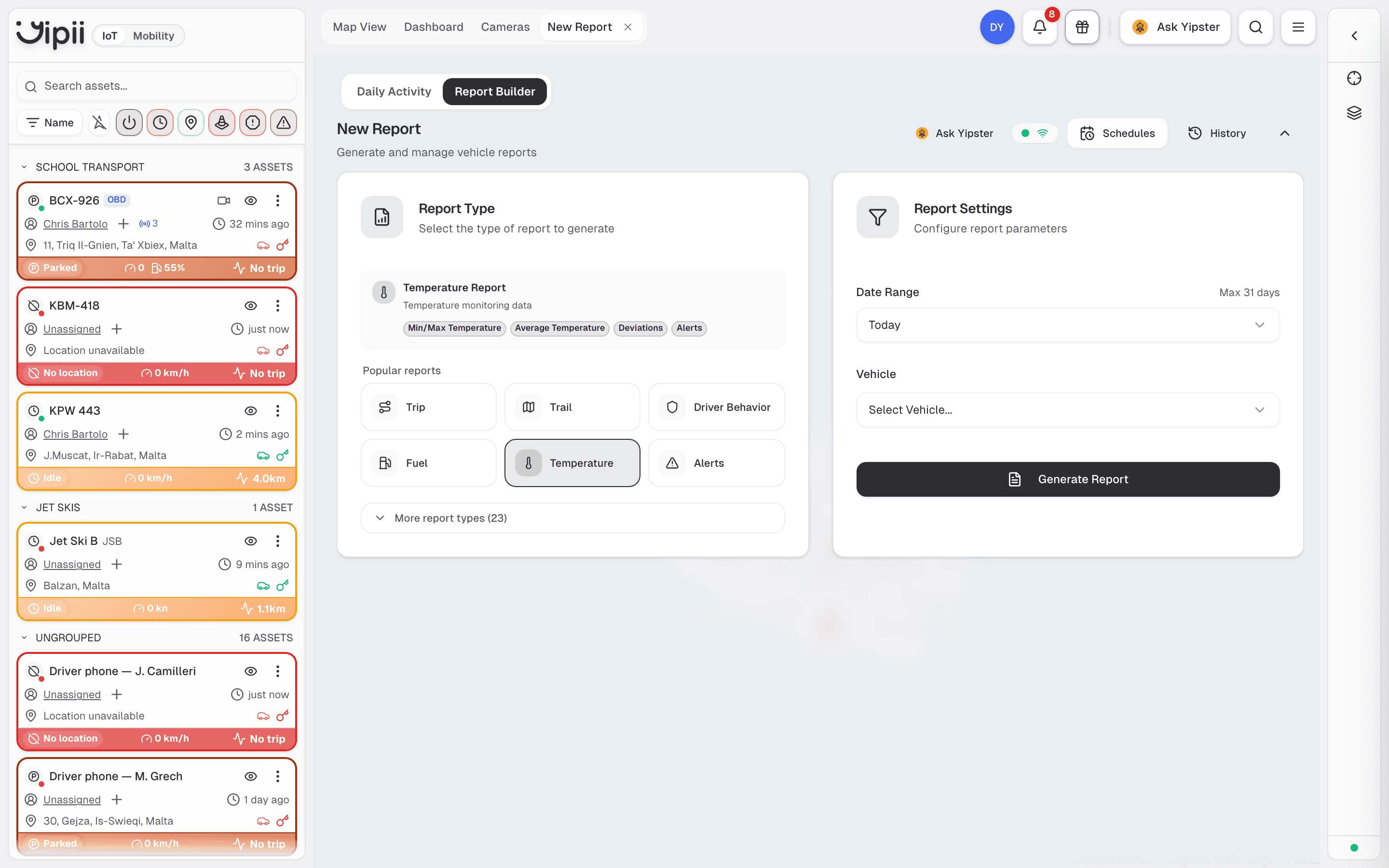
The Temperature report is the record you hand a customer who says the load was warm.
What goes wrong today
- The door is the weak point, not the fridge. Twelve drops means twelve door openings on a hot day. The box recovers slowly and nobody is watching the curve between drops.
- Rejected deliveries you can't contest. Without a temperature record tied to a time and a place, the customer's word wins.
- HACCP paperwork done from memory. Drivers record temperatures on a sheet at the end of the shift, which is not a record — it's a recollection.
- Failures found the next morning. A fridge that quit at 03:00 is discovered at 07:00 when the van is loaded, and the stock is already gone.
- Blame lands on the driver. Sometimes it's the unit, the door seal, or a stacking habit that blocks the airflow. Nobody can tell which.
How Yipii handles it
| Problem | What you use | What you get |
|---|---|---|
| Proving the chill held | Temperature sensors logging continuously to the Temperature report | A time-and-place stamped record per vehicle, exportable to PDF for the customer or an inspector |
| Breaches during the round | Temperature above/below alerts with a sustained-duration hold | A message only when the box is genuinely out of range — not every time a door opens |
| Overnight fridge failure | Alerts that run outside working hours, with per-alert recipients | The 03:00 failure wakes someone who can act, before the van is loaded |
| Which drop caused it | Temperature trace alongside geofence entry/exit at each customer | The breach is tied to a specific stop, not to a shift |
| Fridge unit health | Voltage and power-cut alerts on the refrigeration supply | The unit losing power becomes the alert |
| Multiple compartments | Multiple sensors, and beacon environment monitoring for chilled vs frozen sections | Per-compartment history rather than one number for the whole box |
| Customer confidence | Public tracking links | The customer watches the van approach instead of ringing you |
Set the alert threshold with a sustained duration, not an instant trip. A door opening at a drop will always spike the reading. An alert that fires on every spike gets muted within a week, and then it protects nothing.
A day in the life
04:30 — Van loaded at −18 °C. The overnight trace already shows the box held through the night, so nothing is loaded into a unit that failed quietly.
06:15 — First drop in Birkirkara. Door opens, temperature rises 3 °C, door closes, recovery begins. Within the configured tolerance, so no alert — the record still captures all of it.
09:40 — Fourth drop runs long. The box stays above threshold past the sustained-duration window and an alert goes to the transport manager and the driver, in time to close the door and move on.
13:00 — A customer disputes the morning's delivery. The transport office pulls the Temperature report for that vehicle and window and sends the PDF. The conversation ends.
Friday — A scheduled weekly temperature report per vehicle lands by email and goes into the HACCP file.
What you'll need
Being honest about this saves an awkward conversation after installation.
- Temperature sensors, wired or Bluetooth. The tracker logs them. One sensor reports one place in the box — if you run chilled and frozen compartments, you need one per compartment.
- A tracker with sensor support. Teltonika hardware with BLE or a wired probe. Check the model before ordering.
- Sensible thresholds and a sustained duration. Expect to tune these in the first fortnight against real rounds. Thresholds set from the spec sheet alone generate noise.
- Yipii records temperature; it does not control the fridge. It tells you the box is failing. Someone still has to act.
- Yipii is not a food-safety certification. It produces the evidence your HACCP plan calls for. The plan, and responsibility for it, stay yours.
Typical results
| Lever | Assumption | Annual effect |
|---|---|---|
| Contested rejections avoided | 2 a month resolved with a report, €140 of stock each | €3,360 |
| Overnight failure caught early | 1 a year, half a van of stock | €2,000+ one-off |
| Admin removed | 20 min/day of manual temperature sheets, €14/h | €1,100 |
| Fewer "where is my delivery" calls | 8 calls/day × 3 min, €14/h | €1,600 |
Worked examples using the assumptions shown, not measured customer outcomes. Substitute your own stock values and the model holds.
Get started
- Fit the tracker and sensors, one per compartment.
- Create temperature alerts with a sustained duration, and send them to someone who can act out of hours.
- Geofence your regular drops so a breach can be tied to a stop.
- Schedule a weekly Temperature report into the HACCP file.
Servicing the vans and their fridge units too? Yipii Mobility runs the schedules, work orders and parts for the same vehicles.
Was this page helpful?